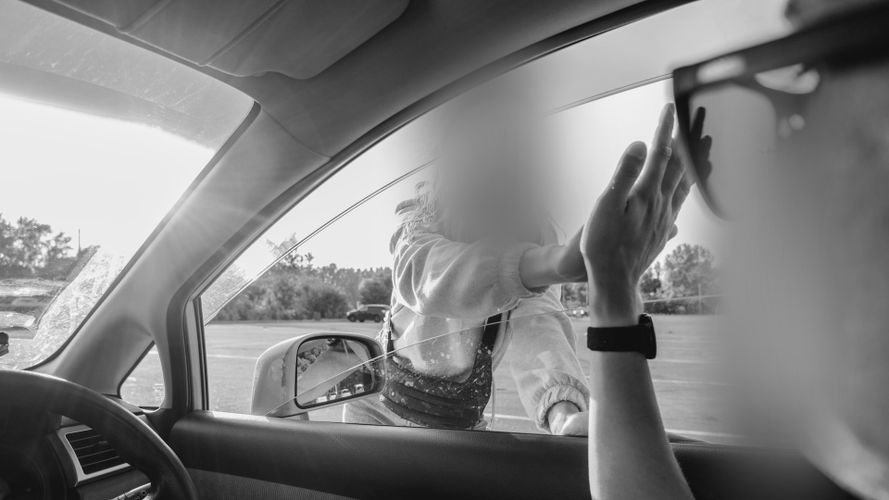
Reflections can undo an otherwise careful redaction. A face blurred in the main frame can still appear in a shop window. A license plate covered on the vehicle can show up in a mirror, a glossy tile, or a car window. These secondary images are easy to miss during review, and a single missed reflection can be enough to make someone reasonably identifiable in the final export.
Visual data anonymization is the process of irreversibly altering visual content in photos and videos so that individuals, and where applicable vehicles, are no longer identifiable. Typical techniques include face blurring and license plate blurring carried out prior to publishing or sharing footage.
Reflections and secondary images create overlooked identifiability
Mirrors, polished glass, glossy tiles, car windows, and screens can reproduce faces and license plates in secondary views. If a person is reasonably identifiable in that reflection, the footage contains personal data and can fall under EU and UK frameworks when published or shared [1][3]. Reflections also appear on curved surfaces, in shop windows after dusk, and in camera lenses as internal flare. In practice, these secondary images are often missed because reviewers focus on the main subject, not the edges of the frame.
Across the market, many anonymization tools struggle with specular highlights, double images from laminated glass, and low-contrast reflections. When a face is clearly visible, detectors often flag it and the face can be blurred. The risk sits in borderline cases where reflections are faint, distorted, partially occluded, or visible only for a few frames during motion.
For teams implementing publish-ready controls with on-premise software, it can be useful to check out Gallio PRO to see how automated blurring and manual review workflows can be combined for real-world publishing scenarios.
Technical challenges by surface type
Different surfaces create different failure modes. Understanding them helps teams place review markers and prioritize where manual checks are most likely to find a missed identifier.
Mirrors and high-fidelity reflections
Mirrors produce the highest-quality copies. If a face is unobstructed in a mirror, it is often detected and blurred. The risk increases when the mirror is angled, cropped, or shows only part of a face. Motion blur and rolling shutter in video can further increase false negatives, especially in the first frames after a cut or a fast camera pan.
Glass storefronts, shelters, and layered materials
Shop windows and bus shelters often introduce multiple layers, tint, and double reflections. Polarization can reduce contrast. At night, interior light sources can produce very clear secondary images that are more recognizable than they appear during daylight review. These scenes commonly include crowds and vehicles, which increases the chance that both faces and plates appear in reflections.
Car windows and curved reflective surfaces
Car windows add curvature, tint, and dirt, deforming facial features and plates. Retroreflective plates can produce bright glare that hides characters in some frames and makes them readable in others. Curved body panels can reflect plates at readable angles when the plate itself is not visible directly, which is why parking and street scenes often require targeted reflection review.
Screens, monitors, and digital displays
Screens introduce moiré, refresh artifacts, and off-axis dimming. Faces on screens, messaging apps, or customer data displays may appear briefly and remain readable in paused frames even if they look faint in motion. Detectors can miss low-contrast screen content, so screens are a common manual-redaction hotspot.
Outcome: high-quality, clearly visible faces or plates are usually detected, but weak or distorted reflections often require human review and manual masking.
Publishing photos and videos: compliance implications across EU, UK, and USA
To avoid repeating the same EU GDPR versus UK GDPR comparison tables across the series, this section focuses on practical implications and adds US considerations. Under EU and UK frameworks, images of identifiable persons are personal data when an individual can be identified directly or indirectly [1][3]. Reflections do not change that. Data falls outside scope only when re-identification is no longer reasonably possible given all means reasonably likely to be used [1]. EDPB guidance on video devices emphasizes careful scoping, transparency, and minimization, especially for footage of publicly accessible spaces [2].
In the United States, there is no single nationwide equivalent to EU GDPR. Even so, reflective identifiability can create practical exposure: complaints, reputational risk, and potential claims under state privacy regimes, biometric laws in some contexts, and common-law privacy theories. The same operational posture that works well in EU and UK programs also reduces US risk: minimize what is disclosed or published, validate exports, and treat reflective identifiers as in-scope when they make a person reasonably identifiable [4][5].
Face anonymization is often used as a safeguard in publishing workflows alongside other legal and operational controls. There are three practical situations often discussed in the context of consent for publishing an image. This is jurisdiction-specific and does not automatically remove EU or UK obligations where personal data remains present:
- the person is a public figure,
- the person’s image constitutes only a minor element of a broader scene, such as a public event,
- the person received agreed remuneration for the use of their image.
The applicability of these situations is context-dependent and varies by jurisdiction. Publishing teams therefore often adopt a cautious, risk-based approach when releasing images online at scale, especially where reflective surfaces increase the chance of unintended identifiability.
License plates: a practical stance for publishing
License plates can be personal data if they enable identification of an individual, in particular when the controller or another party has legal means reasonably likely to be used to link the plate to a person [1]. In many European publishing workflows, license plate blurring is treated as a standard risk-reduction measure. Whether it is legally required depends on context and national practice rather than a single EU-wide rule. In Poland, the issue has been disputed in practice and case law, so assessments remain context-dependent. The UK ICO also treats images as personal data where identification is possible directly or indirectly [3].
Reflection risk map: where teams should look first
Instead of repeating EU GDPR versus UK GDPR tables, the map below focuses on where reflective identifiability most often appears and how it affects publishing decisions in practice, including for US-facing content.
Reflection source | What can reappear? | Why automation misses it | Recommended control | Risk note for publishing (EU, UK, USA) |
Mirrors and polished interiors | Faces, badges | Partial faces, angles, motion blur | Edge-frame review and manual masks on missed reflections | Single-frame re-identification can undermine redaction defensibility |
Storefront glass and shelters | Faces, plates | Low contrast, double reflections, night lighting | Flag night scenes and glass edges for review, increase margins | Broad distribution increases identifiability risk across regions |
Car windows and glossy paint | Faces, plates | Curvature, glare, deformation | Scan parking-lot footage and reflective surfaces near vehicles | Plates and faces may be readable only in reflection frames |
Screens and displays | Faces, names, messages | Moiré, dimming, off-axis angles | Manual review for screen segments and add targeted masks | Screen content can remain readable in paused frames and exports |
What automation can and cannot do today
Automated detection performs strongly when faces or plates are clear. However, challenging optical reflections are not handled consistently across tools. A workable approach is therefore hybrid: apply automatic face blurring and license plate blurring first, then perform targeted manual review of likely reflection hotspots identified during footage mapping.
With Gallio PRO as on-premise software, the automation scope is intentionally focused. The application automatically blurs faces and license plates only. It does not detect logos, tattoos, name badges, documents, or content on screens automatically. Those can be handled in manual mode using the built-in editor. The tool does not blur entire silhouettes. It does not perform real-time anonymization or video stream anonymization. It does not collect logs containing face or plate detections and does not collect logs with personal data or special category data. For hands-on testing, you can download a demo .
Practical workflow to reduce reflection risk
Reflection risk is easiest to control when it is treated as a repeatable checklist item, not a one-off review task. The steps below are designed to fit into a typical publishing pipeline.
- Map reflection sources in footage: mirrors, glazed facades, bus stops, vehicle interiors, and screens.
- Run automated face blurring and license plate blurring with conservative thresholds to prioritize recall.
- Flag frames with strong highlights, night scenes, glass edges, and screens for manual review.
- Use manual tools to blur residual risks such as tattoos, logos, name badges, documents, and monitor content when relevant.
- Keep processing on-premise where appropriate to support confidentiality and access control.
- Document choices and exceptions for auditability, including the segments reviewed for reflective exposure.
If you want implementation support for a specific environment, you can contact us .
On-premise software supports security control and reduces unnecessary transfers
Publishing teams often choose on-premise software to keep raw footage within their security perimeter. This can support confidentiality expectations and reduce unnecessary transfers to third-party processors. Deployment choice is primarily tied to security, access control, and transfer considerations. If you want to evaluate an on-premise workflow with a manual editor for reflection hotspots, you can check out Gallio PRO .
FAQ - Privacy Risk in Reflections (Mirrors, Glass, Car Windows and Screens)
Are faces in mirrors or on screens personal data?
Yes. If an individual is reasonably identifiable from the reflection or screen image, the footage is personal data under EU and UK frameworks [1][3].
Do anonymization models handle reflections reliably?
Not reliably in difficult lighting or geometry. When a face is clearly visible, it is often detected. Weak, distorted, or partial reflections are frequently missed and require manual review.
How should teams audit reflection risks before publishing?
Sample frames from night scenes, shop windows, vehicle interiors, and scenes with screens. Use a checklist to review highlights and glass edges, then apply manual blurring where identifiability remains.
Are license plates reflected on car paint or windows in scope?
Yes. If a plate is readable in a reflection, it can enable identification. Many organisations treat plate blurring as a standard precaution for publishing, but expectations vary by jurisdiction and context.
Is on-premise processing preferable for sensitive footage?
Often yes. On-premise software can avoid cloud transfer and can strengthen security and access control. This is a common compliance approach, not legal advice.
What does Gallio PRO blur automatically?
Faces and license plates only. Logos, tattoos, name badges, documents, and screen content can be blurred in manual mode with the built-in editor.
Does Gallio PRO anonymize in real time?
No. It does not perform real-time anonymization or video stream anonymization, and it does not blur entire silhouettes.