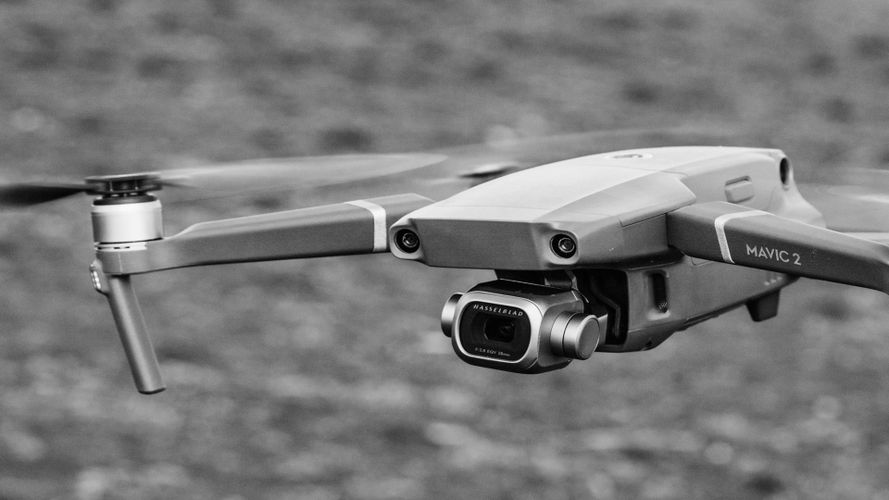
Drone video anonymization is the process of removing or modifying personal data recorded by unmanned aerial vehicles to protect the privacy of individuals appearing in the footage. In practice, this most often involves automatically blurring faces, license plates, and other identifying elements that could violate GDPR or other data protection regulations.
The use of drones for filming and photography is becoming increasingly common - both by public services and private entities. However, with growing popularity comes serious challenges regarding the privacy of individuals inadvertently captured on recordings. Effective anonymization of drone materials requires not only appropriate software but also knowledge of legal regulations and best practices.
The challenge is especially significant when drone footage is to be published or shared with third parties. Therefore, in this article, we comprehensively examine drone video anonymization - from legal aspects, through technical solutions, to practical recommendations for drone operators and data controllers.
Why Is Drone Video Anonymization Necessary Under GDPR?
GDPR explicitly defines an image as personal data, meaning drone videos containing identifiable persons are subject to the regulation. Article 4(1) GDPR defines personal data as information relating to an identified or identifiable natural person, and images undeniably meet this criterion.
The drone operator becomes a data controller under GDPR, carrying many responsibilities - from ensuring a lawful basis for processing, upholding data subject rights, to providing appropriate security measures. In practice, obtaining consent from every person within the drone camera’s range is impossible, making anonymization a key tool for compliance.
It is important to remember that relying solely on legitimate interest as a processing basis is often insufficient, especially for frequent public space filming. Anonymizing recordings before their release or publication significantly reduces the risk of GDPR violations.
The anonymization process should cover all elements that can lead to person identification, not limited only to faces. Comprehensive anonymization should include:
- Faces - the primary feature to blur
- Vehicle license plates - allow indirect owner identification
- Distinctive physical features - tattoos, scars, unusual clothing
- Private properties - especially gardens, terraces, balconies clearly visible from above
- Documents and other personal data materials visible in close-up recordings
Professional anonymization software like Gallio Pro uses advanced object detection and blurring algorithms to automatically identify and anonymize these elements, greatly speeding up GDPR-compliant material preparation.
How Does Facial Recognition Work in Drone Video Anonymization?
Modern drone video anonymization relies on sophisticated artificial intelligence and machine learning algorithms. Facial recognition in this context happens in multiple steps: the algorithm first detects possible facial regions, verifies them, and then applies masking - usually blurring.
The challenge in drone footage is scale variability - faces appear at different distances and angles. Fast drone movement and weather conditions also affect image quality. Therefore, advanced systems like Gallio Pro use deep learning trained on diverse datasets to detect faces effectively even under tough conditions.
Importantly, modern solutions allow real-time tracking of detected faces, ensuring anonymization continuity during dynamic footage. This technology enables processing speeds far exceeding traditional manual anonymization.
Automatic License Plate Blurring in Drone Recordings
License plates are critical for anonymization since they enable indirect identification. Detecting and blurring them in drone footage is challenging due to varying viewing angles and image quality.
Advanced detection algorithms combine pattern recognition with contextual analysis. Unlike ANPR systems aiming to read plate numbers, anonymization systems focus on precise plate localization and effective masking.
Software like Gallio Pro recognizes plates from multiple countries and formats, particularly important near borders or tourist areas. The system automatically adjusts blur intensity, ensuring complete illegibility while preserving the vehicle’s natural appearance.
The choice between on-premise and cloud solutions for drone footage anonymization is critical from data security and compliance perspectives. Both have pros and cons.
On-premise solutions, like the local installation of Gallio Pro, provide complete data control - recordings never leave the organization’s infrastructure. This is crucial for public institutions, uniformed services, or companies handling sensitive data. Local processing also eliminates risks involved in internet data transmission.
Cloud solutions offer greater flexibility, scalability, and often lower entry costs, appealing to smaller or occasional drone footage users. However, they require thorough review of data processing agreements and provider GDPR compliance.
Practically, for organizations regularly processing large volumes of potentially personal drone footage, on-premise is often the safer and more compliant choice.
Effectiveness depends on source quality, type of recorded objects, and anonymization purpose. Techniques include:
- Gaussian blur - a classic, effective, and computationally lightweight method
- Pixelation - enlarging pixels to obscure details, a more noticeable intervention
- Solid color masking - replacing areas with a uniform color
- Morphing - advanced image deformation preserving general context
Adaptive Gaussian blurring is commonly used, adjusting blur according to object size in frame, maintaining anonymity while preserving context.
Effective anonymization must be irreversible - after blurring or pixelation, no existing tools should restore the original image. Anonymization differs from reversible pseudonymization requiring additional information to re-identify data.
Does Artificial Intelligence Aid Drone Video Anonymization?
AI revolutionized drone anonymization by enabling automation and precision beyond traditional methods. Deep learning and convolutional neural networks excel in detecting faces, human figures, and license plates - even in challenging drone footage conditions.
AI greatly accelerates processing - hours of manual work can be near real-time - and increases detection accuracy, reducing overlooked personal data.
Incremental learning systems improve continuously from new data, allowing solutions like Gallio Pro to adapt to specific organizational scenarios, e.g., typical police or municipal drone footage.
Failing to anonymize drone footage - fully or partially - before publishing or sharing can have serious legal repercussions. Under GDPR, insufficient personal data protection constitutes a violation.
Legal consequences include:
- Administrative fines by UODO up to €20 million or 4% of annual turnover
- Civil liability to affected persons
- Violations of other laws, e.g., about image protection (Article 81 of Copyright Law)
- Loss of reputation and public trust
Per Article 82 GDPR, anyone suffering material or non-material damage from violations has right to compensation, meaning even a single improperly anonymized video can lead to costly claims.
Some exceptions exist but are narrowly limited. Typical cases include:
- When all visible individuals have given explicit, freely given, specific, informed, and unambiguous consent (Article 7 GDPR) - practically very difficult with incidental captures
- When the footage concerns a public figure recorded performing official functions, but even then boundaries of privacy must be respected
- For journalistic, artistic, or scientific purposes under strict balancing tests, always following data minimization principles, publishing only necessary fragments
- Make anonymization standard operating procedure - every public or externally shared material should undergo verification and anonymization, preferably using on-premise solutions like Gallio Pro for full process control
- Conduct regular staff training covering legal and technical anonymization aspects to increase privacy awareness and efficacy
- Undertake Data Protection Impact Assessments (DPIA) before new drone applications, identifying risks and mitigation early
- Keep original non-anonymized footage strictly for evidential and operational use, secured both technically and organizationally - dual track approach maintains evidential value and privacy
A Polish regional police command faced challenges publishing drone footage from mass event security operations, which captured thousands of participants. Manual anonymization was extremely time-intensive - processing a 3-minute video took over 8 hours with inconsistent quality posing legal risks. After evaluating options, they implemented on-premise Gallio Pro.
Results included a 95% reduction in processing time to near real-time speeds, anonymization accuracy of over 99% for faces and license plates, and fully local operation keeping sensitive data secure inside police infrastructure.
The anonymization process was integrated with social media and YouTube uploading workflows, ensuring no content publishes without prior anonymization - eliminating human error risk.
Key factors when selecting include:
- Detection accuracy - ability to identify faces and plates under various lighting, angles, and distances, crucial for drone footage
- Processing performance - support for high-resolution footage (4K standard) with hardware acceleration (GPU)
- Security and GDPR compliance - preference for on-premise solutions like Gallio Pro to keep data internal
- Integration - automation across import, anonymization, and export workflows for maximum efficiency
Learn more about integration possibilities with Gallio Pro tailored to your environment.
FAQ: Frequently Asked Questions on Drone Video Anonymization
Do I need to anonymize drone footage if it’s for private use only?
For purely private activities (e.g., recording your property), GDPR “household exemption” may apply. However, if footage covers public spaces or is published online, anonymization is generally required.
How long does drone video anonymization take?
Depends on length, resolution, quantity of objects to anonymize, and computing power. Gallio Pro and similar tools with GPU acceleration can operate near real-time.
Is automatic anonymization 100% effective?
No automatic solution guarantees full 100% efficacy in all conditions, but advanced AI systems exceed 99% success in typical cases. Sensitive materials should receive human verification.
Is anonymization irreversible?
Proper anonymization is irreversible - blurring or pixelation must prevent reconstruction by public tools. It differs from pseudonymization, which is reversible with additional info.
How often should anonymization software be updated?
Regular updates are essential to improve detection algorithms and counter emerging privacy threats. Solutions like Gallio Pro provide cyclical updates enhancing accuracy and adding features.
Are public service drone recordings subject to the same anonymization laws as commercial ones?
Public services may have some RODO exceptions but remain obligated to protect personal data. Publication of such recordings for education or information requires proper anonymization.
Can anonymized drone footage be used as evidence?
Original un-anonymized footage should be securely kept for evidential purposes. Anonymized versions have limited evidentiary value, especially where identification is critical.
Need a professional drone video anonymization solution? Download Gallio Pro demo and see how to secure your footage in compliance with GDPR. Contact us for personalized consultations tailored to your anonymization requirements.